EA ALMA Science Workshop Participation in Kagoshima, Japan
Our team participated in the East Asian Atacama Large Millimeter/submillimeter Array (ALMA) Science Workshop, held at Kagoshima University, Japan, from September 22 to 24, 2025, and successfully presented and shared our recent research results. The EA ALMA Science Workshop is an international meeting hosted in rotation by South Korea, Japan, and Taiwan, the East Asian partners of the world’s largest radio interferometer, the ALMA program. Covering topics from star and planet formation to extragalactic astronomy and cosmology, the workshop serves as a platform for showcasing East Asian ALMA science achievements. This year’s event took place in Kagoshima, a city at the southern tip of Japan, overlooked by the iconic Sakurajima volcano.
Our delegation consisted of Prof. Woojin Kwon, Youngwoo, Junyoung, and Hanju. In addition, alumni Yusuke (Korea Astronomy and Space Science Institute, KASI) and Ilseung (ICE-CSIC, Spain) particiated the workshop and shared their latest results.

Left: Red circle shows the location of Kagoshima.
Right: Sakurajima volcano (photo from Youngwoo).
Our team arrived in Kagoshima on September 20, and there was a small accident. Hanju forgot to bring his backpack from airport bus! Thanks to the swift coordination of Prof. Kwon and Youngwoo and timely help from alumnus Yusuke, the backpack was safely retrieved, and the matter was resolved promptly with no impact on the schedule.

Yusuke safely returns Hanju’s backpack—crisis averted.
Ahead of the main workshop, an informal “Star & Planet Formation” workshop organized by Prof. Shigehisa Takakuwa (Kagoshima University) was held on September 21. The program featured lively discussions on magnetic fields in protostars, accretion streamers, and outflows, followed by a lunch where research ideas and local insights were further exchanged.


Star & Planet formation workshop held on Sept. 21.
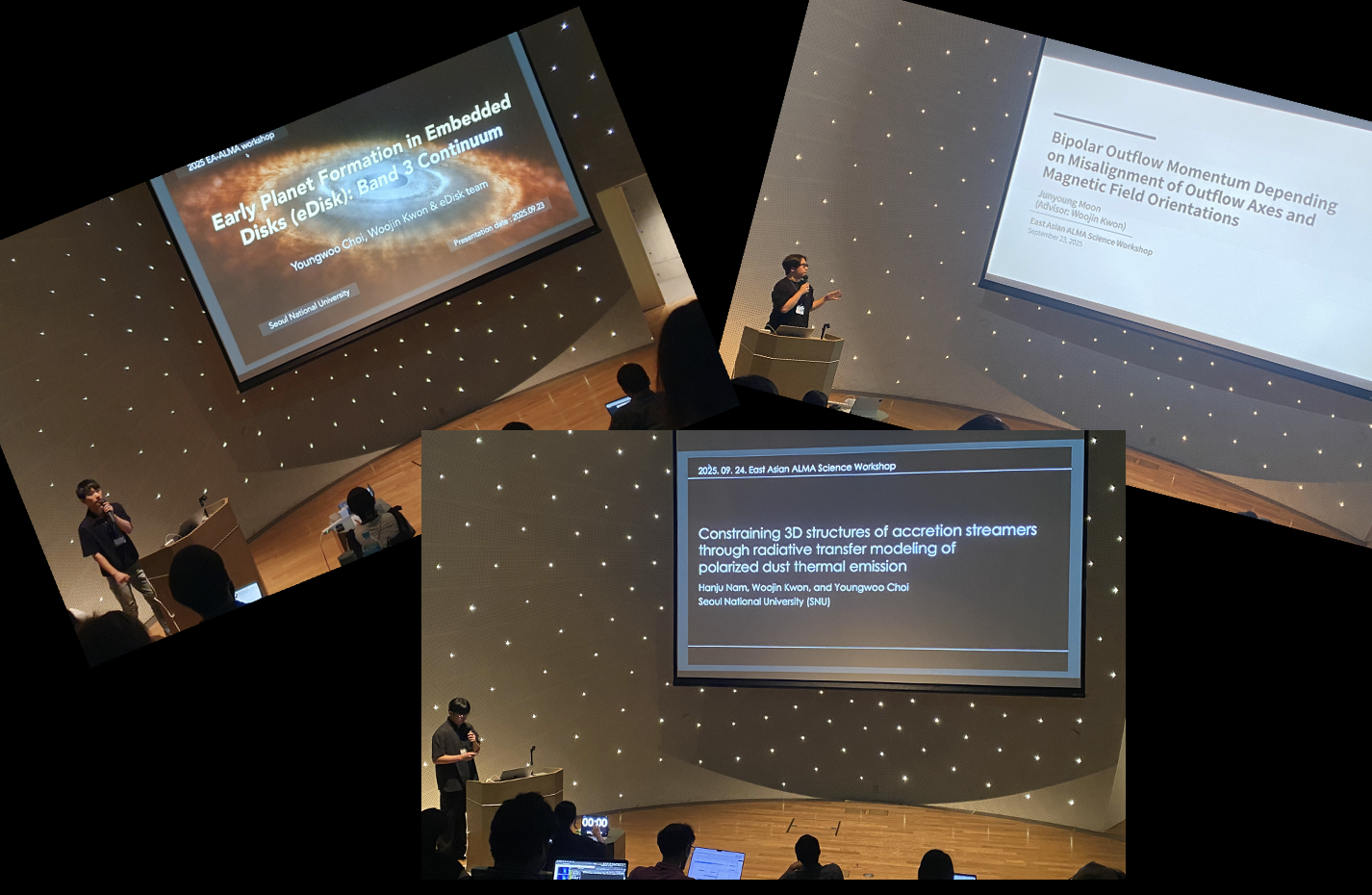
During the three-day EA ALMA Science Workshop (Sept. 22–24), three students from our team (Youngwoo, Junyoung, and Hanju) delivered oral presentations.
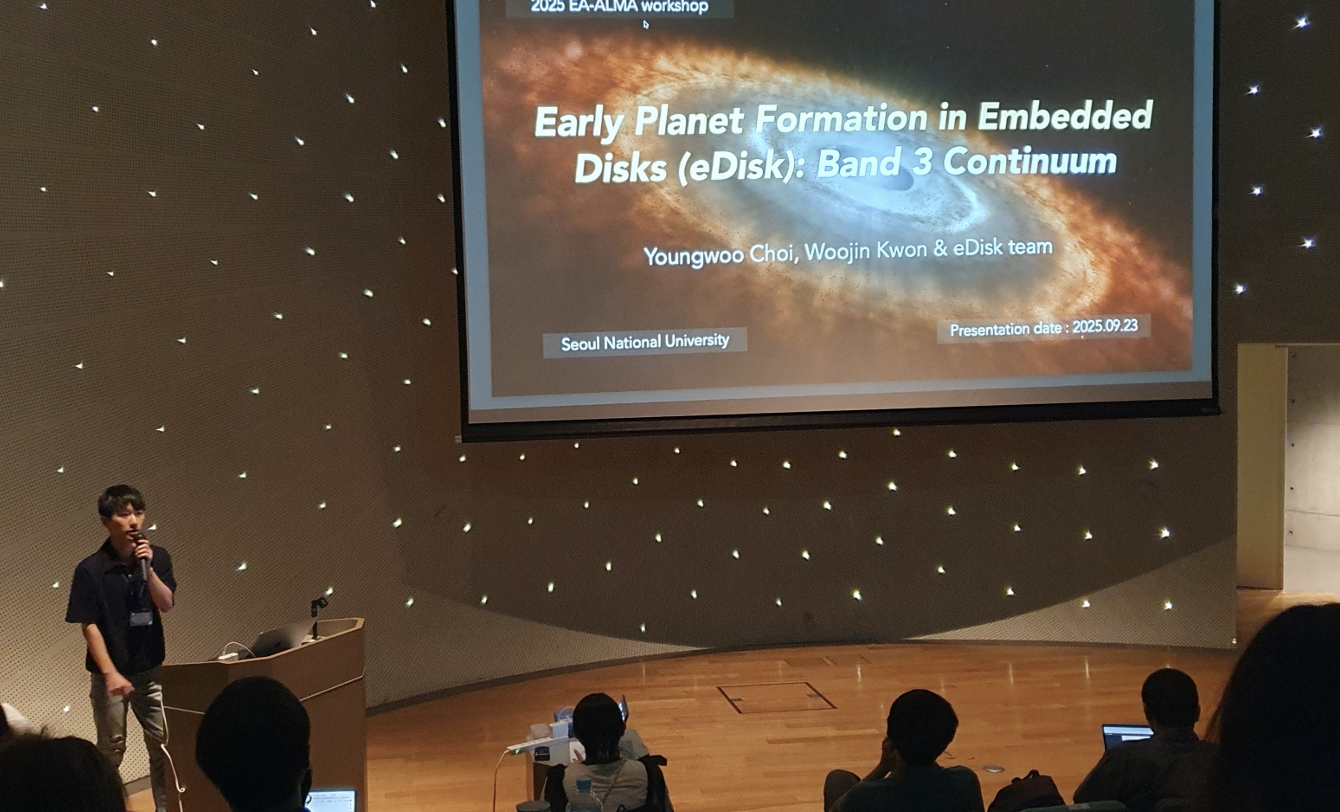
Youngwoo presented observational and modeling results on 1.3 mm and 3 mm dust continuum emission from protostellar disks, as part of the ALMA Large Program eDisk (Early Planet Formation in Embedded Disks).
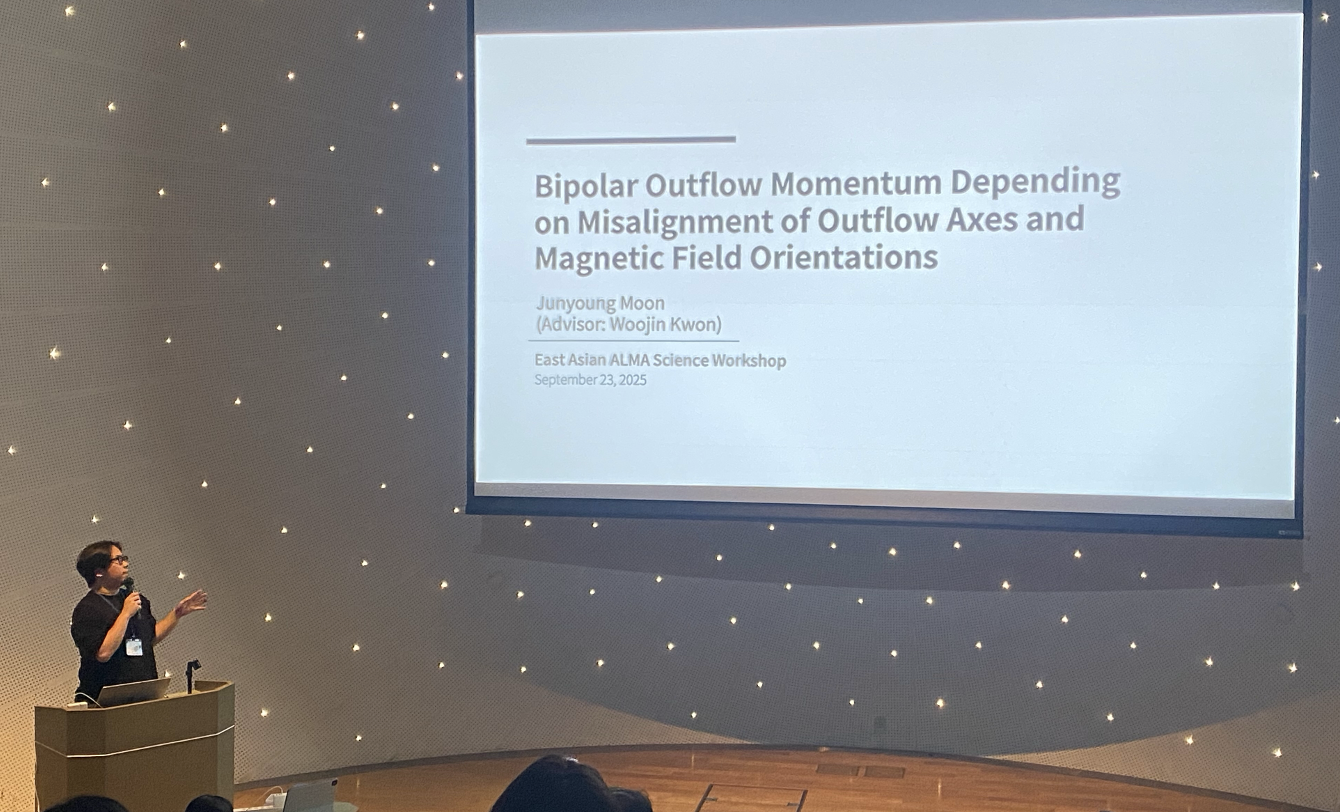
Junyoung reported on the correlation between magnetic fields and outflow momentum across large and small scales, based on combined JCMT and ALMA observations.

Hanju introduced 3D structural and polarization modeling of asymmetric accretion streamers in the vicinity of protostars.
Our team’s presentations drew strong interest and sparked productive discussions with researchers across East Asia and beyond. We also learned a great deal from other talks and posters, identifying new ideas and potential collaborations. Overall, the workshop provided an invaluable opportunity to share our findings, receive constructive feedback, and strengthen international partnerships that will support our next steps in ALMA-based studies of star and planet formation.

Photos in Kagoshima :)